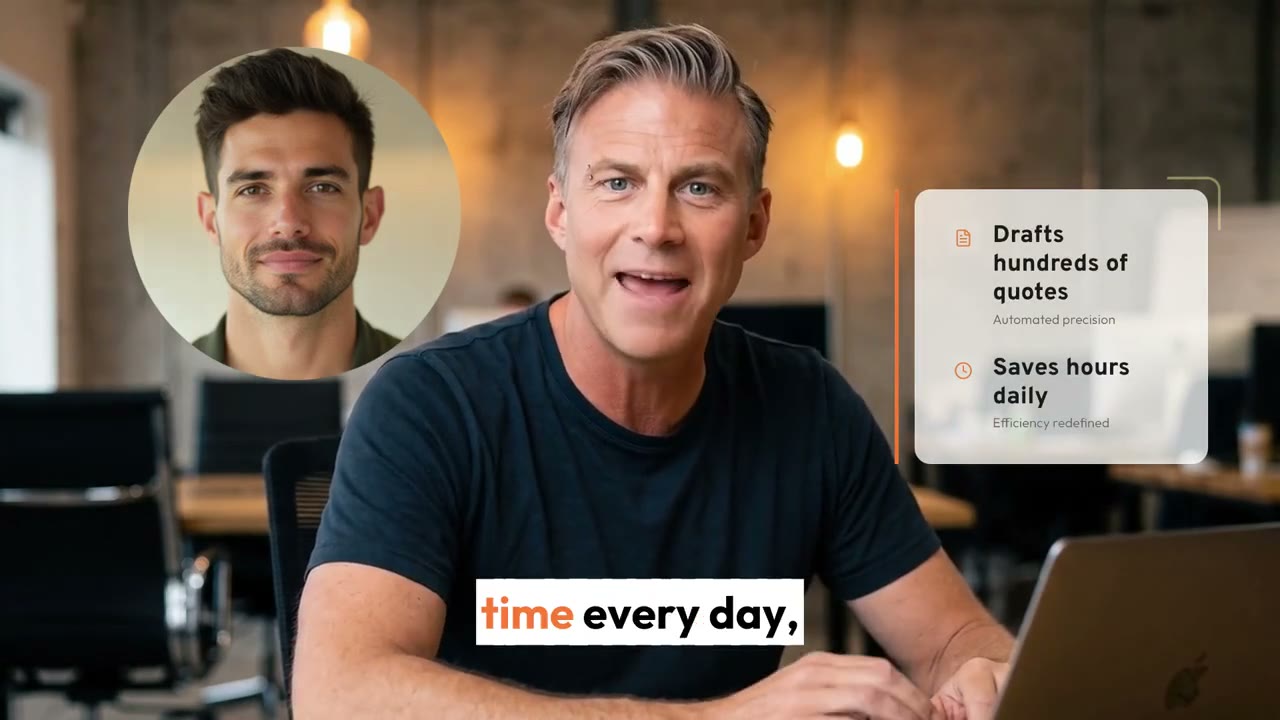
Your office team has priced hundreds of jobs. Every one of those estimates sits in a folder or the job system, and every new enquiry still starts from a blank sheet.
So can an AI agent take that history and draft the next quote? Yes - with a person checking it before it goes anywhere. Here's how I approach it, with Marshall, the quoting agent I built for MSL Fire Protection, as the worked example.
At a glance
- An AI agent can draft a first-pass quote from your past estimates, in your format.
- It needs good examples, your current rates and the rules your estimator carries in their head.
- Marshall, the AI quoting agent I built for MSL Fire Protection, works with Uptick.
- A person approves every quote before it reaches a customer.
- I build on Claude, on your own accounts, so you own the agent and your data stays with you.
- Prices are agreed after a free intro chat.
Can an AI agent really draft a quote from your past estimates?
Yes. An AI agent can work from how you've priced similar jobs before and draft the next quote in your format, ready for someone in the office to check and send.
Your old estimates are the most underused asset in the building. Years of pricing judgement, sitting in a folder called "Quotes FINAL v2".
The agent isn't guessing from the internet. It works from your own history: the jobs you've done, the way you describe the work, the exclusions you always add, the rates you actually charge. That's what makes a draft read like yours rather than a generic template.
What it won't do is replace the person who knows the trade. A survey still needs eyes on site. An awkward building still needs judgement. The agent takes the grind - pulling line items together, scope wording, standard terms - so your estimator spends their time on the calls only they can make.
That's what Marshall does for MSL Fire Protection. When a defect report or a tender lands, Marshall digs out how MSL quoted similar work before, pulls the right products at current costs from their own catalogue, and stages a draft quote in Uptick for the team to review. The full story is in Meet Marshall, and there's more on my AI quoting agent page.
What does the agent need from your old quotes, tenders and job system?
Good examples, your current rates and your rules. Not every quote you've ever sent.
I'd start with one type of job you quote often - an alarm service contract, say, or a routine maintenance visit. Then gather:
- A set of past quotes for that job type that you'd be happy to send again.
- Your current rates and supplier prices. Old quotes carry old prices, so the agent needs today's.
- Your standard wording: scope, exclusions, terms.
- The unwritten rules. "We always add access equipment above a certain height." "We never quote that without a survey."
That last list is the gold. Most of it has never been written down. Getting it out of your estimator's head and into the agent's instructions is half the job - and it's useful to the business before any AI touches it.
Messy files are normal. Part of the build is sorting which old quotes are good examples and which are best forgotten.
How does it work alongside a job system like Uptick?
The agent works with your job system, not instead of it. Marshall works with Uptick.
That matters more than it sounds. Your office team already know where customers, sites and jobs live. Asking them to copy everything into a shiny new tool is how good ideas die by week three.
So I fit the agent around the way your office already runs. The customer and job details stay where they are. The agent drafts, your team reviews, and the quote carries on through the process you already use.
If you run a different job system, the approach is the same. We look at what your system can share, what your team does by hand today, and where an agent can take the copying and retyping off their plate.
The goal is simple: nobody in the office should feel they've gained another system to babysit. If they do, I've built it wrong.
Who checks the quote before it goes to the customer?
A person, every time. Everything the agent does is approved by someone on your team before it goes out, so no quote reaches a customer unchecked.
This is not a box I tick for comfort. It's how the whole thing is designed.
The agent produces a draft. Your estimator or office manager reads it, changes what needs changing, and sends it. If the agent has got something wrong - an odd site, a price that's moved, a customer who always negotiates - the person catches it.
Those corrections are useful too. When the same fix keeps coming up, it tells us a rule is missing, and we add it to the agent's instructions. Over time the drafts need less tidying.
Your name goes on every quote. So a person you trust signs off every quote. That doesn't change because an AI agent wrote the first draft.
Where does your estimate data live, and who owns the agent?
In your accounts, and you own it. I build on Claude, on your own accounts, so the agent is yours and your estimate data stays with you.
No black box. You can see how the agent is set up, what it's been told and what it works from. Your pricing history is the most commercially sensitive thing in the office, and it shouldn't end up locked inside someone else's platform.
That's also why I build on your accounts rather than mine. You hold the keys. You decide who on the team has access. If your needs change, you're not stuck asking permission to get at your own quotes.
I'm an Official Claude Partner, and Claude is what I build every agent on. It's strong at the careful, long-document work that quoting is full of: reading old tenders, following detailed rules and writing in your house style.
How much time could it save your office team?
At MSL Fire Protection, Marshall drafts in minutes rather than hours and saves the team hours every day. Your saving will depend on your jobs, your files and how consistent your quoting already is - so I won't give you a number for your office before we've measured it.
What I'd suggest instead is measuring it properly. Before we build anything, have your team note how long a typical quote of that job type takes today, from enquiry to sent. Then compare once the agent is drafting.
The biggest wins tend to be in the quotes that follow a pattern: repeat work, standard maintenance, jobs your team could price in their sleep but still have to type out. Those are the ones I'd point the agent at first.
The complex tenders still need your estimator. The point is to give them their afternoons back for those, not to pretend a draft replaces their judgement.
How do you start, and what does it cost?
Start with a free 20-minute intro chat. Prices are agreed after that chat, once I understand what you quote and how your office works.
Here's roughly how it runs:
- We talk. You tell me what you quote, which job system you use and where the time goes.
- We pick one job type. One that's frequent and fairly predictable.
- We gather the examples and rules, and I build the agent on your own Claude accounts.
- Your team uses it with a person approving every quote, and we tune it from their corrections.
I work in person across Sussex and London, and remotely across the UK, so hop on a call wherever you are. Loop in your estimator or office manager if you can - they'll know where the bodies are buried in the old quotes.
Book a free 20-minute intro chat and do let me know what you quote. I'll tell you honestly whether an agent would help.